Archive for the ‘Christmas’ Category

Door 4: A Cow and a Bear Walk into a Bar…

December 4, 2007

advent4.jpg

Okay, you know that verse about how the lion shall lie down with the lamb? Do you know what part of the Bible it’s in? Turns out it’s in the same section where we find the oft-(mis)quoted verse “God helps those who help themselves.” That is to say, nowhere, at least not in quite those words. Pondering this coming Sunday’s lectionary reading from the Hebrew scriptures (Isaiah 11.1-10), it struck me that although the lion and lamb turn up in close proximity, Isaiah presents us with a somewhat different vision than the one I’d been carrying around in my head. Here’s how it goes, in part:

The wolf shall live with the lamb, the leopard shall lie down with the kid, the calf and the lion and the fatling together, and a little child shall lead them. The cow and the bear shall graze, their young shall lie down together; and the lion shall eat straw like the ox. (Isaiah 11.6, 7 NRSV)

I had totally forgotten about the cow and the bear. Something about their paired appearance in this magnificent vision—one of the Bible’s most beautiful and powerful descriptions of a world set right—just struck me funny. It sounds like a setup for a Far Side cartoon. A cow and a bear are in a bar, see…

Anyhoo, the image of that cow got me thinking about the person who first taught me about lectio divina (Greek for sacred reading), the ancient art of praying with the scriptures and other sacred texts. Sr. Kathleen, a Dominican nun who introduced me to lectio as she led a clergywomen’s retreat years ago, sometimes calls this form of prayer “lectio bovina” for its ruminative, meditative, contemplative quality. Lectio invites us to take a small bite of a text—a few verses or perhaps just a few words—and slooooowly chew on them, and ponder them, and pray with them, until they give up something that will provide sustenance for our soul and nourishment for our work in the world.

Lectio offers a terrain that in some ways is like the landscape of a dream. Doing this kind of sacred reading with a text, especially a visionary text such as the one Isaiah offers, bears similarities to how we might reflect on a dream. In the contemplative space of lectio, we ponder the variety of associations and connections between the text and our own story. If the text offers characters to us, we may look for how they reflect different parts of ourselves and what they might have to say to us. We imaginatively engage the symbols and metaphors that the written words present to us. And we look for the possibilities that our more rational minds might never have conjured up—those soul-invitations that we sometimes have a hard time noticing otherwise. Lectio is the necessary, complementary counterpoint to Bible study; within its borders, connections and possibilities surface that we might not otherwise have been able to imagine.

Like a wolf living with a lamb, and a cow and a bear grazing together. Ruminating on this vision that Isaiah offers, I’ve found myself wondering, What are the natures I carry within myself? What are the names of the creatures who pace in my soul, and how do they live together in a way that offers a glimpse of the kingdom, a foretaste of a time when all things will be reconciled? How can the “someday” that Isaiah foresees become a vision that begins to take root right now in my life? What unimagined connections, pairings, possibilities might God be challenging me to entertain in these Advent days and beyond?

A blessing upon your ruminating.

Door 3: Where the Question Is Born

December 3, 2007

Image: Where the Question Is Born © Jan Richardson

After I scanned today’s collage door and uploaded it to my blog, ready to sort through some of what I’d been pondering while creating it, I suddenly thought, Hm, aren’t those Mardi Gras colors? A quick online search brought the information that the traditional colors of Mardi Gras—purple, green, and gold—symbolize justice, faith, and power. Mardi Gras (French for “Fat Tuesday”) is, of course, the festival that precedes the season of Lent. Its name refers to the practice of consuming all the tasty fat-containing foods in the house before entering into what has traditionally been a season of fasting. In many places around the world, Mardi Gras is a period of intense celebration, part of an ancient, cross-cultural impulse to seek balance: between plenty and lack, play and work, festal time and ferial time.

The colors that emerged in today’s door got me thinking about Lent and its resonance with the season of Advent. While the church calendar cleanly divides the year into liturgical seasons that have their unique emphases, they also have points of connection and commonality. Ordinary Time still contains the occasional feast day, the high holy seasons still have their moments of ordinariness, liturgical colors and symbols sometimes make their appearance in more than one season. Purple, a color symbolizing both royalty and penitence, accompanies us through Lent; recognizing Advent’s resonance with Lent, the church has often used purple during Advent as well (though some congregations use blue to distinguish the season).

Advent and Lent are both seasons of preparation. Their scriptures and symbols engage us with the events leading to crucial moments in the life of the incarnate God: birth, death, resurrection. Advent and Lent contain a world of wisdom about how to live into the vast mysteries that come with being people of Emmanuel, God-with-us. How do we wrestle with the questions that get stirred up by the stories of a God who went through birth and death and resurrection? How do we carry the questions that arise from the births and deaths and resurrections that occur and recur in our own lives and in the lives of those we journey with?

In her lovely, you-should-buy-it-for-Advent-if-you-don’t-already-have-it book The Vigil: Keeping Watch in the Season of Christ’s Coming, Wendy Wright passes along an observation from the novice master of a Trappist monastery she once visited: “To be a Christian does not mean knowing all the answers; to be a Christian means being willing to live in the part of the self where the question is born.”

Advent and Lent are seasons for mindfully entering the mysteries, for giving particular attention to the part of ourselves where questions are born. These seasons each remind us that we don’t have to figure out the mysteries all at once. We journey into them, we work at them (and let them work on us) day by day, we spiral back around them year by year. We recognize that each season contains its own measure of birth and death and rising again.

Advent beckons us to remember that even as we anticipate birth, we are challenged to let go; to make way for what is coming, we give up whatever would hinder us from receiving it. Sounds a lot like Lent. And sounds a lot like our whole lives. One of the gifts of the liturgical seasons is that they invite us to give particular focus to the stuff that surfaces all along our path.

What questions are you carrying in this season? How are birth and death and resurrection intertwined for you in these days? Is there any letting go you need to do, that new life can find a place to take hold in you?

Happy AdLent to you.

[To use the image “Where the Question Is Born,” please visit this page at janrichardsonimages.com. Your use of janrichardsonimages.com helps make the ministry of The Advent Door possible. Thank you!]

Door 2: Sleeping with Kilian

December 2, 2007

Image: Sleeping with Kilian © Jan Richardson

“The night is far gone, the day is near,” we hear in today’s Epistle reading for the first Sunday of Advent, from Paul’s letter to the Romans (13.12). The night was far gone indeed when I finally turned off my computer in the wee hours of this morning and took myself to bed. As often happens when I’ve worked far into the night, I lay awake for a long while. I generally think of myself as a good sleeper, but when I’ve kept my brain working past its usual schedule, it tends to punish me by staying in high gear even though I go through the usual rituals of quiet and reading that mark the ending of the day.

I’ve learned that the best medicine for my insomnia is poetry. There’s something about reading good poetry at night that often breaks the cycle of sleeplessness, something about its landscape that soothes my brain and beckons slumber. Opening a book of poems becomes a prayer for rest: incantation, benediction, their words coax the sleep that I haven’t been able to command.

Last night, Kilian McDonnell was my featured guest on The Insomnia Show. Father Kilian is a Benedictine monk of Saint John’s Abbey in Collegeville, Minnesota, who became a poet in his so-called retirement. At last year’s retreat of the oblates of Saint Brigid of Kildare Monastery, which we hold each summer at the Episcopal House of Prayer on the grounds of Saint John’s Abbey, Fr. Kilian spent part of an afternoon with us, reading some of his poems and sharing about his life as a poet. He was enchanting; our session with him was one of my favorite parts of the retreat.

During last year’s retreat, which we hold over the Feast of St. Benedict, we attended the Feast Day Mass at the Saint John’s Abbey Church. Fr. Kilian was among the jubiliarians that year—those monks being recognized for significant anniversaries of their monastic profession. Fr. Kilian, who is now 86 years old, was celebrating 60 years as a monk. His poems, and the language he finds to talk about his work as a poet, bear witness to how six decades of praying the Liturgy of the Hours can shape the soul of a poet.

Fr. Kilian’s second collection of poems, Yahweh’s Other Shoe, appeared last year, published by Saint John’s University Press. It was this volume that I pulled out in the far-gone night. With the day near, I gave my brain over to Kilian’s words. Then I turned out the light, and I slept, his slim volume beside me like a talisman through the brief hours that remained of the night.

A few hours later, I was in church, where we heard the Gospel reading for this first Sunday of Advent. Matthew does the Gospel honors this year: “Keep awake, therefore,” he records Jesus as saying, “for you do not know on what day your Lord is coming” (Mt. 24.42).

Keep awake. Gotcha.

I came home and took a nap.

But of course Jesus isn’t speaking literally here; he is talking about being ready, about cultivating a state of soul that is perpetually ready to recognize and welcome him. Pondering his words about wakefulness, I’ve found myself remembering an article that Thomas Moore, known for such books as Care of the Soul, wrote for Parabola magazine a few years ago. Writing about threshold spaces as places that are crucial for our soul’s journey, Moore offers an intriguing take on our approach to consciousness. He writes, “Religion is in the business of finding and constructing methods of getting sleepy, feeling lost, arriving and departing: pilgrimage, procession, fasting, incense, chanting, illuminated books.” (I think again of Psalm 122, the song of pilgrimage and procession that we hear on this first Sunday of Advent.) Moore goes on to observe,

Often we attain thresholds best through inadvertence. If we want their benefits, we might not always aim for consciousness and awareness, but rather a gap in our attention. In my view, the emphasis in some spiritual communities on continuing consciousness defeats the purpose. (From Moore’s article “Neither Here nor There,” Parabola, Spring 2000.)

He’s not arguing against awareness, of course; he’s making a case that awareness and wisdom and soulfulness don’t arrive solely through perpetually vigilant consciousness. There’s a different kind of wakefulness that comes in giving ourselves to practices that cultivate a mindfulness of mystery. I love the litany of examples that Moore offers, and add my own: walking, lectio divina, lingering at the dinner table with friends, creating or encountering artwork.

Poetry.

The scriptures of the Advent season give us rich images of the value of getting sleepy in the way that Moore writes about. The people we meet in the stories of this season receive wisdom in dreams, they offer songs that are ancient poems, they go on pilgrimage and walk in ritual processions. In so doing, they become people who are deeply awake to the presence of God moving within and around them. They find that receiving God’s intense attention is not always easy or comforting but that it reshapes them at a soul level, calling them to engage and offer the very core of who they are.

I find myself wondering how I’ll let myself get sleepy in this season, what habits of inadvertence will take me across the thresholds that God offers in these Advent weeks. How about you? What practices help you be present to the God who delights in meeting us not only in our focused awareness but also in the gaps in our attention, in dreams, in mystery?

Sleep well.

[To use the image “Sleeping with Kilian,” please visit this page at janrichardsonimages.com. Your use of janrichardsonimages.com helps make the ministry of The Advent Door possible. Thank you!]

Door 1: Crossing the Threshold

December 1, 2007

Image: Crossing the Threshold © Jan Richardson

Here in Florida, the seasons are subtle. We do have them, really. I’m a native Floridian, several generations over, and I sometimes find myself quick to assert our seasonfulness to folks who claim we don’t have them. It’s just that, excepting occasional hurricanes, our seasons are…quiet. I can appreciate that some people need a bit more drama in their landscape. Me, I’m content having a wardrobe that doesn’t involve lots of wool and long underwear, and keeping a weather eye for the hints that a new season is in the works.

Still, the fact is that I have the windows open and am wearing shorts on this first night of December, which feels slightly odd even to me. I think maybe it’s this kind of wintry weather that first piqued my interest in the liturgical year. In the absence of having dramatic climatic clues that alert me to the changing of seasons, I find that attending to the liturgical calendar helps me know what time it is.

The Christian calendar tells us that we’re on the threshold of Advent, the season that beckons us to anticipate and prepare for the celebration of the birth of Christ. These weeks leading up to Christmas are a time to keep our eyes on the horizon: to watch, to wait, to keep vigil for the one who is to come. But these Advent days draw our eyes not only toward the future. This is a season of deep memory, a time when we are called to hear again the ancient stories of the God who has journeyed with us from the beginning and who, in the fullness of time, took on flesh and came to walk in this world with us.

Time can do strange things in this season, as we navigate our way through the call to both remember and anticipate, to give our attention both to the past and to the future. Perhaps, in the midst of this, the greatest challenge is to be present to these days, to find a footing that enables us to savor the season in its daily, hourly unfolding.

Like many folks, it’s right around Christmas Eve that I start thinking, Okay, now I’m ready to really begin Advent! Sometimes it seems that it’s only when I’m done with the doing of Christmas—when I’ve finished all the physical preparations—that I’m ready to attend to the internal preparations, to open my soul to the God who is ever waiting to be born there. Of course, it’s a little late to start Advent at that point. Though God is ever ready with grace, even (and perhaps especially) on Christmas Eve, I’m wondering what it would look like to do things a little differently this year.

I’ve found myself thinking lately about Advent calendars. I was flipping through a Bas Bleu catalog a couple weeks ago and came upon some cool Advent calendars they’re featuring. Depicting such places as Westminster Abbey, St. Petersburg Church, and the Vienna Christmas market, these calendars offer, like most such calendars, little doors to be pulled open one by one from December 1 to 25. It’s a way of marking time, of charting our passage deeper into this season of anticipation and giving us daily treats along the way.

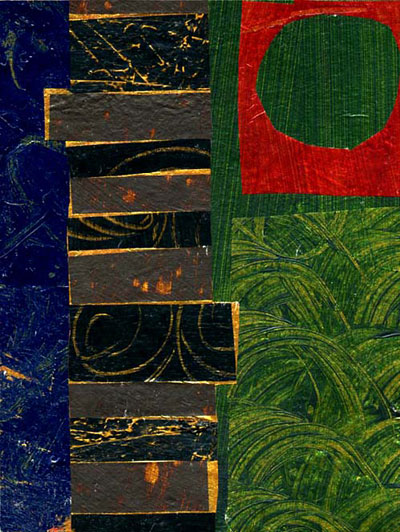
This year, I’ve decided to create something of an online Advent calendar. I’m making a series of wee little collages, three by four inches, that I’m thinking of as doors into these days. I’ll be working on them as I reflect on the scriptures and stories that are part of the Advent landscape, particularly this year’s lectionary readings for the Sundays of Advent. It’s a tactile way of doing lectio divina (sacred reading); the collages are a way of entering the sacred texts, of crossing the threshold anew into the ancient stories of the birth of the Word who became flesh. Each day I’ll post a collage, and we’ll see what words are waiting behind the door.

Today I’ve been pondering the Psalm for the first Sunday of Advent (Year A in the Revised Common Lectionary). Psalm 122 is a festival psalm, a song lifted up by pilgrims as they enter Jerusalem and approach the Temple.

I was glad when they said to me,
“Let us go to the house of the Lord!”
Our feet are standing
within your gates, O Jerusalem. (1, 2 NRSV)

It’s a song of crossing the threshold, of entering into a longed-for landscape. Crossing through the gates, arriving at the holy place, the pilgrims’ song becomes a prayer for peace:

“Peace be within your walls,
and security within your towers.”
For the sake of my relatives and friends
I will say, “Peace be within you.” (7, 8 NRSV)

It’s a good blessing on this Advent Eve. It’s nearing midnight as I write this. “The night is far gone,” the apostle Paul writes to the Romans (in what happens to be the Epistle reading for tomorrow), “the day is near.” The day, and the door: into Advent, into a new season, into a new year.

Peace be within you.

[To use the image “Crossing the Threshold,” please visit this page at janrichardsonimages.com. Your use of janrichardsonimages.com helps make the ministry of The Advent Door possible. Thank you!]